Meet Red, the vehicle of choice for the Moroccan Rally 2012. A 1964 ex-military Land Rover Series 2A SWB, registered for civilian use in 1972 and turning 49 years old for this rally. Red is no stranger to the Sahara: this is her third time in the desert.
The last time Red was in the Sahara she suffered a number of failures, including one that was very nearly fatal for the car. A snapped chassis, a head gasket failure (which meant running on only three cylinders for the majority of the previous road trip), clutch failure, gearbox failure (second gear disappeared entirely), and overheating. Red, however, is a sturdy beast, and has since been fitted with an electronic ignition, a rebuilt gearbox, new shock absorbers and an improved braking system.
- Model
- 1964 Ex-Military Land Rover Series 2A SWB
- Engine
- 2.25 L petrol
- Power
- 70 BHP
- Top speed
- 65 MPH with some tailwind
- Nickname
- Red
- Creature comforts
- Comfy seats and a loud stereo system
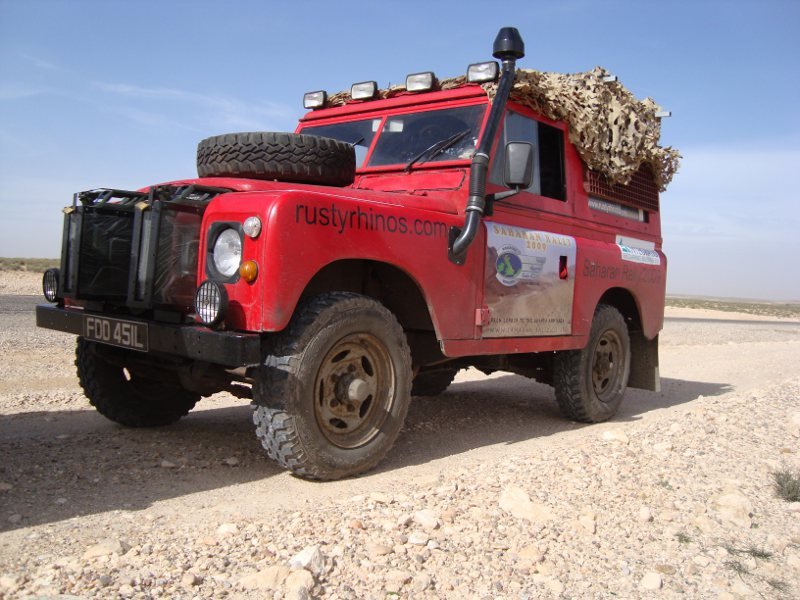
Modern cars are great. They're usually pretty reliable, quite economical, and they've evolved significantly over the years. That's all well and good, except that it's all far too sophisticated and reliable for us to have any real sense of adventure. So yet again we opted for something a bit older.
The Red Shed
By Lewis Collard, 7th April 2012
A lot of people have heard of the Rusty Rhinos' adventures across the Sahara. Behind the scenes, there was a Herculean amount of work that went into preparing Red, the nearly-50-year-old Land Rover, for the task. I'm here to tell you all about it.
I'm Lewis Collard, and I'm part of the Rusty Rhinos ground crew. My speciality is removing propshafts, mostly because nobody else wants to do it. I also function as a human painting jig, as seen below.

You all know of Red as this tough, desert-conquering beast:
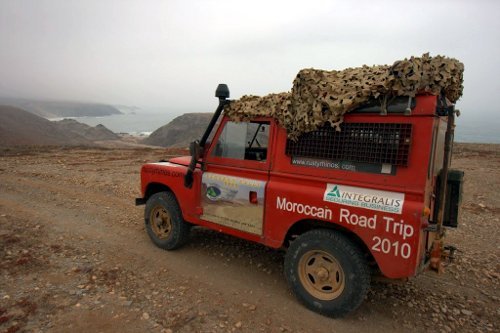
But what we started with was something rather different.
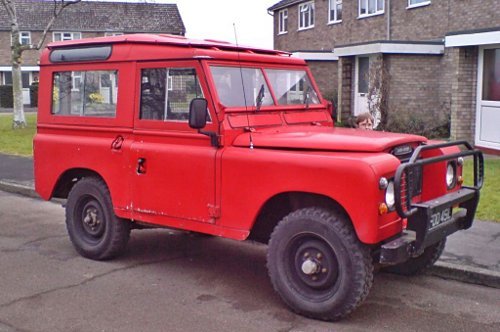
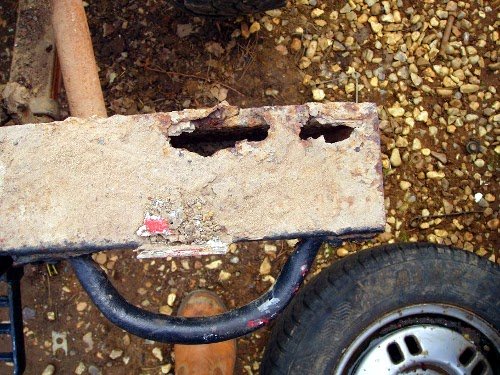
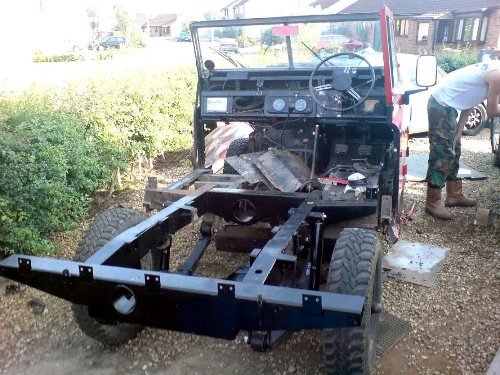
Here's the Land Rover, affectionately nicknamed Red (or "The Red Shed"), as Alex bought her: £500 from an eBay auction titled simply "Land Rover". She's an ex-military Series IIA 2.25 petrol, built in 1964 and decommissioned from the military in 1972. She had an MOT, which is supposed to be some kind of indicator of roadworthiness. What you might not know is that MOT testers are not allowed to poke around too much, or to knock anything so hard that holes will appear. You can see the logic in that, but if a vehicle is going to cross the Sahara, it also makes sense to prod around a little more vigorously. We prodded around a lot more vigorously, with hammers and screwdrivers and other implements of destruction, and found some pretty horrible things.
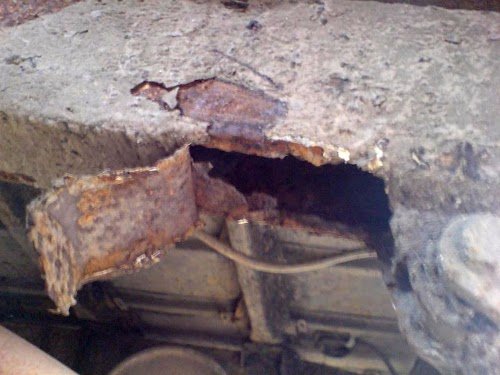
That was an especially egregious example, but we did find plenty of rust, and where there wasn't rust there were awful half-hearted repairs. In the end, we ended up stripping Red right down until she was literally an engine, bulkhead and gearbox sitting on half a chassis.
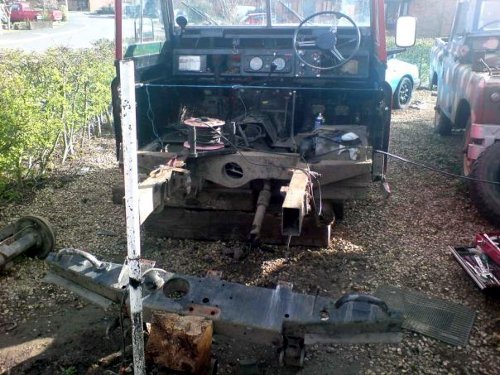
The chunk of chassis hacked off in the photograph above included a completely rotten rear crossmember.
I won't attempt to detail all the welding work we had to do. If you want that, pick up a Land Rover parts catalogue and put ticks next to all of the steel components. In short, though, our job for months of weekends was mostly welding, fabrication, welding, and preparation for welding when we weren't busy welding welding welding.
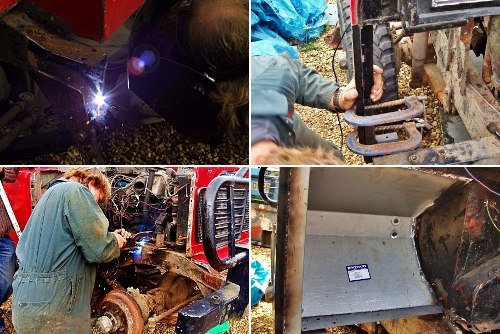
When I say "our job", the actual welding was carried out by the other member of the Rusty Rhinos ground crew, Maurice. Say hi to Maurice, the actual man behind the mask.
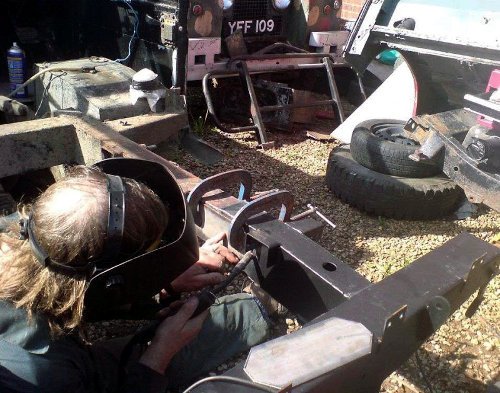
Here he is welding the new rear quarter-chassis in place (the section that was cut off in the earlier picture). On top of his considerable welding skills, his vast knowledge of Land Rovers was indispensable in bringing this once-rotten, half-knackered Land Rover back to life, and we certainly could not have done it without him. Thanks, Maurice.
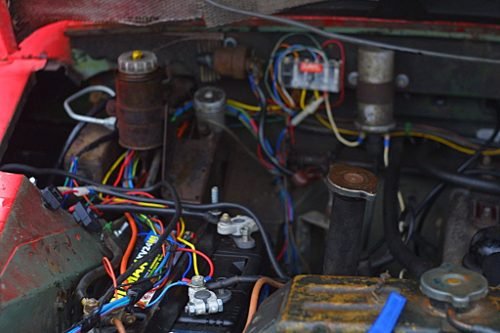
Most people would not consider a nearly-half-century-old Land Rover a suitable vehicle for crossing the desert, because it's extremely primitive. We found it the perfect vehicle to prepare for the desert precisely because it is so primitive. Electronic systems, power steering, air conditioning and other modern conveniences can't go wrong if they never existed in the first place. One issue we came across is that the electrics in the vehicle were there but huge chunks of it needed replacing; it was a mix of stuff that worked, stuff that didn't, and decades of "that'll do" quick fixes. Rather than try to isolate the sections that didn't work, we solved the problem by ripping out the electrics and rewiring the entire Land Rover from scratch.
All this ties in with the Herculean amount of work, but of course this would have been a much more enormous job if the Land Rover weren't such a brilliant, simple vehicle. I doubt that anyone short of a masochistic electrical engineer would dare take on such a project on a modern vehicle, for fun.
Incidentally, Red has two very large batteries: one for the critical systems, and another for less-critical systems like the extra lights. Part of this is so that heavy use of those less-critical systems can never render the car unable to start. A secondary benefit is that there's no need to carry a spare battery: if the battery powering the critical electrical systems fails, you can swap the leads around and start the car from the auxiliary battery. Both batteries are charged simultaneously by an alternator from a first-generation Range Rover, which more than copes with the extra load.
Among many, many other things, we replaced all the suspension components. We also replaced the brakes, end to end, including all the brake lines.
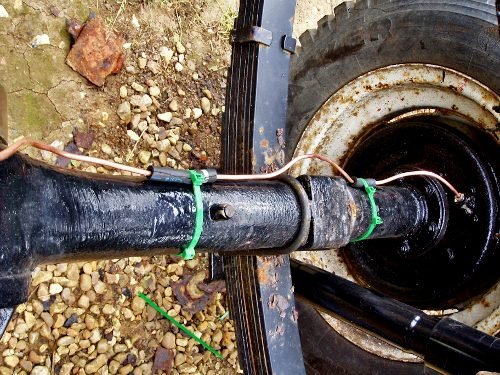
Here's a free lesson that'll save you some time, and possibly your no-claims bonus: never buy aftermarket (pattern) brake parts. We've had horrendous trouble with braking systems when using non-genuine parts, by which I mean "having no brakes when they're most desperately needed". Given how many times we have replaced said aftermarket parts, we'd have saved money and spared ourselves a few frightening experiences by going for the slightly more expensive genuine components right from the start, which work flawlessly. We learned this lesson the hard way so you don't have to.
These are two of the creature comforts: actual seats, with actual seatbelts.

The seats came from a Mark III Vauxhall Cavalier and the seatbelts were from a Land Rover Series III. It required considerable strengthening and modification of the standard Land Rover seat box, of course, but it was definitely worth it: they're fantastically comfortable. (I modified two nearly-identical Astra seats for use as desk chairs, where they also serve very well.)
All in, to get Red into a fit state for her first MOT in the Rusty Rhinos' possession (and a fit state for taking a pounding in the Sahara) took us eleven months. Eleven months is a lot of time; we had plenty of moments where it felt like it would never be finished, and maybe one or two "let's weigh it in" moments too. Did I mention that we were rebuilding a second beast from Solihull all the while?
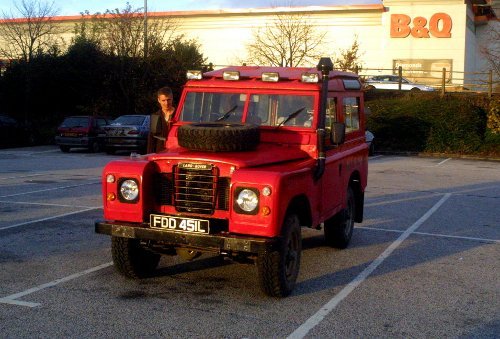
Two trips to the Sahara, in addition to one shortly to come, have taken a heavy toll on the old Land Rover. The second one literally split her in half (hastily patched up in a garage in Morocco), and she has had her share of other less-drastic incidents since. Red is an ongoing project. Among many other things, she has had a rebuilt gearbox, electronic ignition, and new shocks since the last trip. We fully intend to keep her loved and running through her half-century birthday, and long past that.
Long live the Red Shed.
Lewis Collard, Rusty Rhinos ground crew
Further reading
A longer-form companion piece to The Red Shed, written by Alex and kept on file alongside the rally:
Life & Times of the Landie — Part II — PDF, 9.3 MB, 92 pages. Alex's detailed account of Red's life on and off the rallies.